
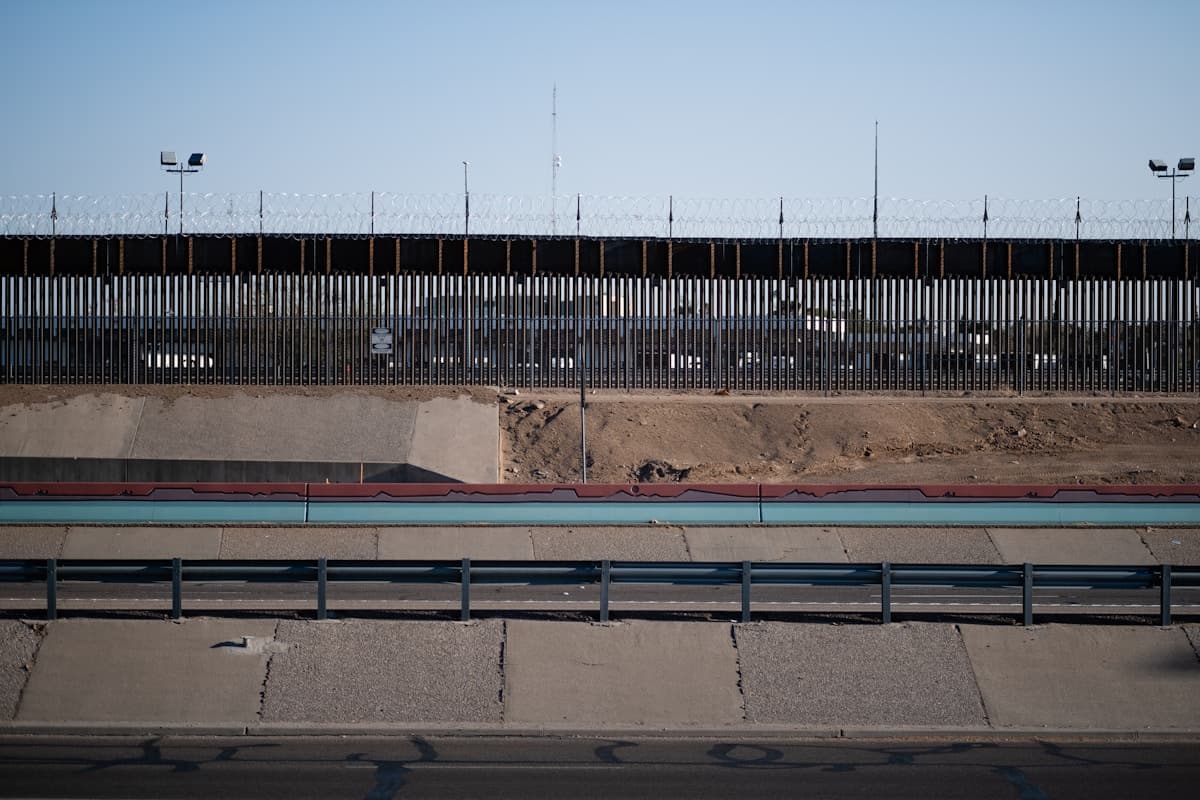
The Net and the Shadow
On January 20, 2026, President Trump's second-term inauguration reached its first anniversary. That same day, the Department of Homeland Security (DHS) announced in a press release that the number of noncitizens ICE had deported, removed, or expelled since the inauguration had surpassed 675,000 — a figure it called the highest on record. This total includes not only formal removals under a final removal order from an immigration judge, but also voluntary departures and expedited removals at the border, so opinions differ on what the real scale of deportation is. Even so, it is clear that the figure itself is unprecedented.
The scale of the number alone is not the problem. As the machinery of deportation speeds up, people who should have slipped through its gears keep getting pulled in along with everyone else. Young people with valid DACA (Deferred Action for Childhood Arrivals) status have been arrested while appearing at immigration offices; a person whose removal a court had barred was sent to a prison in El Salvador; and measles has broken out at a tent detention facility in the Texas desert. This column looks at specific cases to examine how far the safeguard of due process is still holding up as the government pursues speed and scale in deportation.
Behind the Number 670,000
"Statistics state facts, but statistics without context create misunderstanding. — Mark Twain"
Breaking down the roughly 675,000 total deportations and removals DHS announced reveals a different picture. The figure mixes together formal removals (removal) carried out under a final removal order from an immigration judge, voluntary departures (return), and expedited removals at the border. According to internal ICE records obtained by the Daily Caller on March 4, 2026, the number of cases in which a final removal order was actually issued and executed is far smaller than the headline total. Based on the trend in those internal records, analysts project that formal removals for fiscal year 2026 will total only about 85,000. The gap between the announced figure of 675,000 and the actual number of formal removals is substantial.
Comparative context is needed. In FY2024, the Biden administration's last full fiscal year, ICE removals totaled about 271,000; in FY2025, which includes the first year of Trump's second term, the total was about 340,000 — roughly a 25% year-over-year increase, confirming that deportation activity has genuinely expanded. Still, it should be noted that a large share of the announced 675,000 figure comes from immediate returns at the border, cases involving people who spent almost no time inside U.S. territory. Combining interior ICE arrests with border returns into a single announced number makes it difficult to grasp the actual character of immigration enforcement.
The detained population, without dispute, has hit a record high. As of mid-January 2026, roughly 73,000 people were held in ICE detention facilities — the most in ICE's 23-year history, and an 84% increase from about 40,000 during the same period in 2025. According to an analysis by Syracuse University's TRAC (Transactional Records Access Clearinghouse), of the 70,766 people in detention as of January 25, 2026, 74.2% — about 52,500 people — had no prior criminal conviction. Even among detainees with a criminal conviction history, only 5% of the total had a conviction for a violent crime, according to the Cato Institute's analysis. The Trump administration has publicly stated its goal of expanding detention capacity to around 100,000. Professor Austin Kocher of Syracuse University has calculated that 92% of the growth in FY2026 detention numbers came from people with no criminal record. As troubling as the pace at which the numbers are rising is the legitimate question of who, exactly, makes up those numbers.
DACA Recipients Arrested at the Immigration Office Door
"When the law arrests, in its own name, the very person it promised to protect, the foundation of trust is shaken. — Bryan Stevenson"
On February 18, 2026, Maria de Jesus Estrada Juarez, who lives in Sacramento, California, appeared at a USCIS (U.S. Citizenship and Immigration Services) office for her green card interview. She had lived in California for 27 years, had held DACA status since 2014 and renewed it five times, and had no criminal record whatsoever. When she arrived at the interview location, an ICE agent was waiting for her. She was arrested, and the next day, without ever receiving any legal hearing, she was deported to Mexico. According to ABC10 Sacramento's reporting, her family said she was never even given a chance.
DHS said that Estrada Juarez had received a final removal order back in 1998, but she denied ever having received any such order. Secretary Kristi Noem said the case would be reviewed, but by then the deportation had already been carried out. On January 20, 2025, his inauguration day, the Trump administration formally rescinded the sensitive-locations policy that had traditionally restrained enforcement at churches, schools, and hospitals. Arrests outside immigration offices have become possible as an extension of that policy shift. When the very government agency that ordered a person to appear for an immigration interview is followed by a different arm of that same government making an arrest at the door, it erodes basic trust in the immigration system.
According to tracking by the immigrant advocacy group Home is Here, at least 22 cases have been confirmed in which people with valid DACA status were arrested, detained, or deported since the start of Trump's second term. Official DHS data released in February 2026 records that, from January through November 2025, 261 DACA recipients were arrested and 86 were deported. The government states that most of the DACA recipients arrested had criminal records, but according to KJZZ's reporting, some of the individual cases documented by Home is Here involve people with no criminal history who were deported while waiting on renewal paperwork. In Nebraska, DACA holder Joel Angel-Becerril was arrested by ICE, but after an ACLU lawsuit, an immigration judge dismissed the removal proceedings on the basis of his DACA protection and released him. The fact that some holders of the very same program are deported while others are released raises real questions about the consistency of the arrest criteria.
DACA is not a law enacted by Congress but a discretionary administrative program. DHS maintains the position that DACA confers no legal status whatsoever, and litigation over the legality of the program itself is ongoing in federal court in Texas. What DACA holders fear most is not deportation itself, but the possibility that the personal information they trusted the government with could be used to track them down. Whether the address, employer, and school information submitted to USCIS in a DACA application can be used as ICE enforcement data is an area the administration has, to date, not clearly denied.
What Cannot Be Undone After Deportation
"Admitting a mistake is hard, but undoing one is sometimes impossible."
Kilmar Abrego Garcia was a Salvadoran immigrant working in Maryland. In 2019, an immigration judge had issued an order barring his removal to El Salvador on the grounds of his fear of gang violence. Yet on March 12, 2025, he was arrested by ICE, and three days later, on March 15, he was transferred to CECOT (Terrorism Confinement Center), El Salvador's maximum-security prison. A man who had been going to work in Maryland just a week earlier ended up locked in a Central American prison. Government attorneys admitted in court that this had been an administrative error.
On April 10, 2025, the U.S. Supreme Court ordered the government to facilitate Abrego Garcia's return. The administration initially objected, arguing it lacked the authority to do so given El Salvador's sovereignty, but under court order it returned him to the United States on June 6, 2025. What awaited Abrego Garcia upon his return was a criminal indictment on human smuggling charges. His defense argued that the indictment was retaliation for his legal fight against the administration, and Tennessee federal judge Waverly Crenshaw ruled that there was a realistic likelihood of vindictiveness behind the prosecution.
NPR reported in February 2026 that while the Abrego Garcia case was initially treated as a singular mistake, similar wrongful deportations have kept recurring. One of his attorneys said that he alone was representing more than 12 plaintiffs in cases similar to Abrego Garcia's. In April 2025, a 20-year-old Venezuelan man, and in July, a 31-year-old Salvadoran man, were each confirmed to have been wrongfully deported and then returned under court order. The attorney's assessment was blunt: the problem is not improving — it is getting worse.
It is essentially impossible to determine the exact number of wrongful deportations. When an immigrant without a lawyer is wrongfully deported, there is often no channel at all through which to contest it or even document it. A report from the U.S. Government Accountability Office (GAO) found that ICE deported 70 people who may have been U.S. citizens between 2015 and 2020. If even citizens can be wrongfully deported, then people holding visas or waiting on green card applications are inevitably in a more vulnerable position. Legal experts broadly agree that the confirmed cases represent only a fraction of the total.
A Tent in the Texas Desert: Camp East Montana
"Building a facility costs money, but protecting people takes will."
Camp East Montana, built on the grounds of Fort Bliss military base outside El Paso, Texas, is currently ICE's largest detention facility. It is built and operated under a $1.2 billion contract by Acquisition Logistics LLC, a small government contractor based in Richmond, Virginia, with a maximum capacity of 5,000 people. As of mid-February 2026, roughly 3,000 people were being held there.
The facility's history has been troubled from the start. A worker died during construction, and within six weeks of opening, three detainees lost their lives. An autopsy determined that the death of one of them, 55-year-old Cuban national Heraldo Lunas Campos, was a homicide by asphyxiation. ICE initially reported his death as medical in nature, then later changed its account to describe it as the unintended result of physical force used to prevent self-harm. Follow-up reporting by PBS NewsHour confirmed the autopsy findings.
Sanitation and health problems recurred repeatedly. In January 2026, two cases of tuberculosis and 18 cases of COVID-19 were reported, and in early March, 14 confirmed measles cases triggered a full lockdown of the facility. 112 people were placed in quarantine, and outside access to the facility was barred through at least March 19. Las Americas, an immigration legal organization based in El Paso, said it had become impossible to meet with detainees — attorney visitation rights were effectively suspended. An ACLU report also documented testimony that a lack of laundry facilities forced female detainees to wear the same clothing for weeks.
An inspection conducted by ICE's own Office of Detention Oversight at the 50-day mark found at least 60 violations of federal detention standards. In a December 2025 report, the ACLU described detainee beatings, sexual abuse, denial of medical access, and failure to provide meals. Members of Congress from Texas sent a joint letter to DHS urging attention to the inhumane treatment inside the facility.
On March 4, 2026, the Washington Post reported, based on internal documents, that ICE was drafting a letter to terminate the facility's $1.2 billion contract, and the Texas Tribune confirmed the same. NBC News likewise reported that DHS was reviewing the facility's future. DHS said the contract was under review but that no final decision had been made; the current contract is set to expire in September 2027. Even if a single facility is shut down, the question of who bears responsibility for what happened inside it remains a separate matter.
Closing
The administration's determination to speed up deportation shows up in the numbers. A total of 675,000, a detained population of 73,000, and a string of record-breaking superlatives are all presented as policy achievements. But inside those numbers are a DACA recipient who had lived in the United States for 27 years, a man whose removal a court had barred, and 52,000 people held in detention despite having no criminal record. A detainee who caught measles under the tents of Camp East Montana, and a man whose death was ruled a homicide, are part of those numbers too.
The wider the net is cast, the more likely it is to catch things that should never have been caught in it. Due process is not the opposite of efficiency — it is the minimum condition for an immigration system to function properly. The fact that it took a Supreme Court order to bring Abrego Garcia back from a Salvadoran prison shows just how high the cost can be when procedure is skipped. For anyone currently going through an immigration process, keeping copies of every document related to your legal status, and getting legal advice before appearing at any government office, is a realistic form of preparation. In a reality where people the government promised to protect are being deported by that same government, documentation and legal representation are nearly the only means a person has left to protect themselves.
Disclaimer: This column is provided for general informational purposes only and does not constitute legal advice for any specific case. For matters concerning your individual immigration situation, please consult an immigration attorney.
Law Office of Jin D. Cho, P.C.
NEW YORK OFFICE (Flushing) 35-24 154th Street, Flushing, NY 11354
(T) 718-353-2699 (F) 718-353-8132
NEW JERSEY OFFICE 560 Sylvan Avenue, 3Fl., Englewood Cliffs, NJ 07632
(T) 201-449-0009