
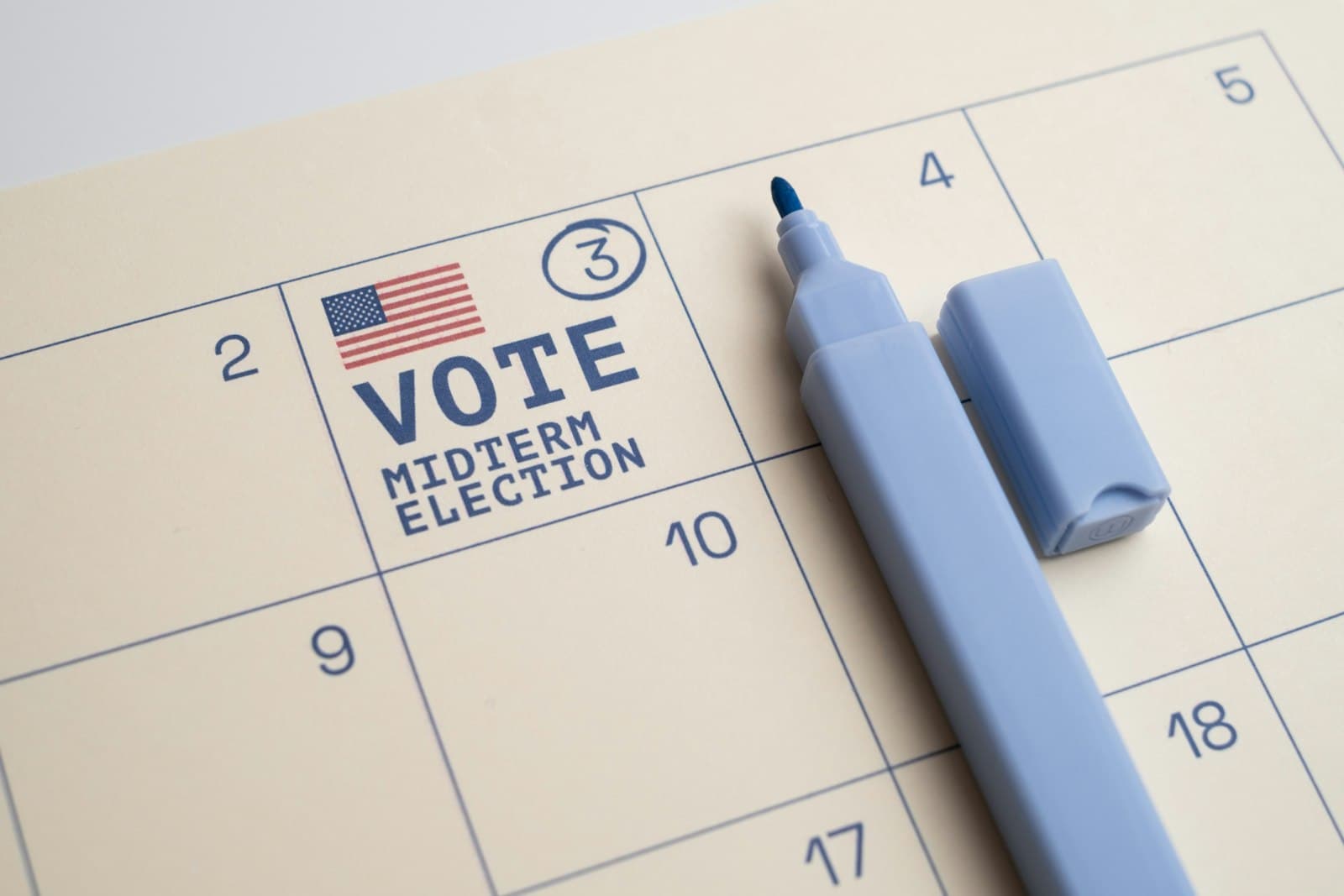
The election changed the mood, but the power to enforce immigration law and decide cases still rests with the executive branch
In the November 3 midterm elections, Democrats won both the Senate and the House. In the Senate, they flipped seven Republican seats to reach 54 (NBC tally as of the evening of November 5, with Alaska and Mississippi not yet called), and in the House, they gained roughly 40 seats and will become the majority. Democrats also won a majority of governorships for the first time in 16 years. Rising prices, corruption, and the Iran war are all cited as reasons Republicans lost, but the exit polls reveal another major factor: backlash against the harsh enforcement led by Immigration and Customs Enforcement (ICE). This column sorts out what may change after the election and what remains the same.
Six in 10 Voters Said Enforcement Had Gone Too Far
"In the NBC News exit poll (as updated on the night of November 4), 58% said the Trump administration's immigration enforcement had 'gone too far,' 20% said it had 'not gone far enough,' and 22% said it was 'about right.'"
Ninety percent of those who said it had gone too far voted for Democratic candidates. Sixty percent also said they opposed the way ICE operates.
Latino voters were where the vote shifted sharply. According to the same exit poll, 46% of Latinos voted for President Trump in the presidential election two years ago, while 34% of Latinos voted for Republican candidates in this House election.
Immigration had long been a Republican strength. According to a September Fox News poll, voters had said for the past four years that Republicans handle immigration better, but that advantage nearly disappeared this summer. The Republican pollster who worked on the survey explained that voters now think of ICE enforcement when they hear "immigration policy," and that many people feel that enforcement has been too aggressive.
This does not mean the demand to secure the border has gone away. In this exit poll as well, when asked which party would handle immigration better, Republicans still held a slight edge, 43% to 41%. What voters turned against can be seen as the way enforcement was carried out on the streets, more than border control itself.
The Backlash That Grew After the January Events in Minneapolis Carried Into the Election
"In an NPR/PBS News/Marist poll (January 27–30, 2026), 65% said ICE had 'gone too far' in enforcing immigration laws, up 11 percentage points from 54% in June 2025."
This poll came out right after two U.S. citizens were shot and killed by federal immigration agents in Minneapolis in January. On February 4, Democratic leaders set out 10 reforms as conditions for supporting funding for the Department of Homeland Security, the department ICE belongs to. They included banning agents from wearing masks, requiring a court warrant to enter private property such as a home, visible identification, and body cameras.
When Republicans did not accept them, Homeland Security funding lapsed for about 11 weeks starting February 14. Even during that time, ICE and Border Patrol kept operating with money they had received under last year's budget law. In March, the replacement of Homeland Security Secretary Kristi Noem was announced, and her successor is Secretary Mullin. House Speaker Johnson said Republicans were in "course correction" mode, saying the perception that enforcement had gone too far had cost them with Latino voters. On April 30, funding was released only for the rest of the department, excluding ICE and Border Patrol. Money to buy body cameras was included, but core demands such as the mask ban and warrants were left out.
In June, Republicans used a budget procedure that lets them pass a bill without Democratic votes to set aside about $70 billion separately for ICE and Border Patrol. The House vote was 214 to 212. This law left out not only the warrant requirement and mask ban that Democrats had demanded, but also a body camera requirement that had support from both parties.
Different voices also began to emerge within the Republican Party in the fall. Senator Roger Marshall of Kansas, who had said in January that collateral damage sometimes happens, demanded in September that ICE work with local police if it wanted to operate in Kansas. Senator Marshall lost his seat in this election.
Republican Representative Maria Elvira Salazar of Miami told the President in a September campaign ad that some of the enforcement had gone too far. On election night, she said voters had clearly told Republicans to correct course on the economy and immigration.
The Lame-Duck Period Has Begun, and Enforcement Tactics Are Being Discussed Even Within the Administration
"Under the Twentieth Amendment to the U.S. Constitution, the new Congress's term begins at noon on January 3, 2027, and the President's term ends at noon on January 20, 2029."
Under the Constitution, President Trump cannot be elected president again. Now that his party has also lost its majority in Congress, the remaining two years are what is commonly called a lame-duck period. The calculations of Republican lawmakers facing the 2028 elections may also change.
Robert Garcia, the incoming chair of the House Oversight Committee, which Democrats will lead, named the activities of the Department of Homeland Security and ICE as an area to investigate. Congressional committees can hold hearings, subpoena witnesses, and compel the production of documents. Once what happens in the field starts going on the congressional record, incident by incident, agents may also become more careful.
Within the administration, too, there has been talk that enforcement tactics could change. On November 4, Vice President Vance said that while he opposes an amnesty that would give legal status to undocumented immigrants, he could accept changing enforcement to focus more on businesses that hire illegally.
Beware of Premature Optimism
"Homeland Security Secretary Markwayne Mullin posted a single sentence on social media on November 4: 'Deportations will continue.'"
The power to direct enforcement still rests with the executive branch. Both the roughly $70 billion allocated in June and the ICE funding received under last year's budget law can be spent until September 30, 2029. Because this money moves separately from the budget set each year, the new Congress has little room to pressure ICE through the budget.
Even if Congress tries to change the law, the President can use his veto. On election night, President Trump said he thought he could work with Democrats on immigration, but he also called the veto one of the strong powers the President holds.
Nor can anyone conclude that Democrats will take up immigration first. In a letter to his colleagues on November 4, House Democratic Leader Jeffries highlighted that Democrats had not funded "Trump's violent mass deportation machine." But the items he listed for the first 100 days were health insurance, food assistance, tariffs, and the Iran war, and immigration was not among them.
Until the new Congress takes office on January 3, the current Republican Congress keeps working as it is. The temporary federal funding expires on December 11, and four immigration programs extended by the same law, including the non-minister religious worker immigrant program and the electronic employment eligibility verification system (E-Verify), also end that day. How they will continue depends on the negotiations between now and then.
A lame-duck administration may actually rush regulations and executive actions that do not have to go through Congress. CNN reported that administration lawyers are reviewing executive actions in the immigration area, such as tightening visa rules. Two proposals are currently open for public comment before being finalized: one that would charge a fee for optional practical training (OPT), post-graduation work authorization for international students (comments due November 9), and one that would eliminate the rule under which prior approvals were generally given deference when a work visa is extended under the same conditions (comments due November 13).
Arrests at interviews have not stopped either. On October 23 in Minneapolis, a man sponsored by his U.S. citizen wife was arrested by ICE in the middle of his green card interview. According to the couple, his immigration court hearing notice went to an old address he had left more than two years earlier, so he never appeared in court, and a removal order had been issued without his knowledge. An immigration judge recognized that the husband had not received the notice, and he was released in early November.
Conclusion
The election has clearly changed the mood. But it takes time for laws and regulations to actually change, and in the meantime, each person's case is decided under the current rules. There are three things to do now. First, do not put off your application while waiting for policies to change. Second, if you have an interview coming up or plan to leave the country, first check whether you have a case in immigration court and whether the address you reported to USCIS is your current address. You can check for an immigration court case on the case lookup website (acis.eoir.justice.gov) by entering your A-number (the number on your green card or USCIS notices) and your country of nationality, or by phone (1-800-898-7180). Not every case shows up, so you cannot assume you are safe just because nothing comes up. Even if you changed your address with USCIS, if you have a case, you must separately notify the immigration court. Third, if you are an employer, get your employees' Employment Eligibility Verification forms (Form I-9) in order. If enforcement tactics change, workplace enforcement may increase.
Frequently Asked Questions
Q. Now that Democrats have won the Senate and the House, will immigration enforcement decrease right away?
It is hard to expect an immediate decrease. The new Congress's term begins at noon on January 3, 2027, and the power to direct enforcement still rests with the executive branch. The roughly $70 billion allocated to ICE and Border Patrol in June can be spent until September 30, 2029, and even if Congress tries to change the law, the President can use his veto. The Secretary of Homeland Security said the day after the election that "deportations will continue."
Q. Should I hold off on my green card or visa application based on the election results?
We do not recommend putting off your application while waiting for policies to change. It takes time for laws and regulations to actually change, and in the meantime, each person's case is decided under the current rules. Regulations that do not go through Congress are also still moving forward: a proposal to charge a fee for optional practical training (OPT), post-graduation work authorization for international students, and a proposal to eliminate the rule under which prior approvals were generally given deference when a work visa is extended under the same conditions are both open for public comment before being finalized.
Q. How can I check whether I have a case in immigration court?
You can check on the immigration court case lookup website (acis.eoir.justice.gov) by entering your A-number (the number on your green card or USCIS notices) and your country of nationality, or by phone (1-800-898-7180). Not every case shows up, so you cannot assume you are safe just because nothing comes up. Even if you changed your address with USCIS, if you have a case in immigration court, you must separately notify the immigration court of your address. In October in Minneapolis, according to the couple, a man was arrested in the middle of his green card interview after his immigration court notice went to an old address and a removal order was issued without his knowledge.
Disclaimer: This column provides general information and is not legal advice for a particular case. Individual immigration matters should be discussed with a qualified immigration attorney.
Law Office of Jin D. Cho, P.C.
NEW YORK OFFICE (Flushing) 35-24 154th Street, Flushing, NY 11354
(T) 718-353-2699 (F) 718-353-8132
NEW JERSEY OFFICE 560 Sylvan Avenue, 3Fl., Englewood Cliffs, NJ 07632
(T) 201-449-0009
choattorneys.com | Marriage green card online: greencard4spouse.com